EB Welding Used on Small Components for Nuclear Pharmaceuticals
A manufacturer of radiopharmaceutical therapies was constructing a cyclotron used to accelerate particles and compound chemicals for cancer detection and nuclear medicine treatments. Due to the volatility of the materials involved and the critical nature of the application, the metal components used within the cyclotron were required to meet extremely stringent engineering and cleanliness standards.
The parts were exposed to high heat and high stress during operation, and any failure—mechanical or material—could compromise the production of sensitive isotopes. As a result, both the material selection and the welding process were tightly controlled.
The Challenge
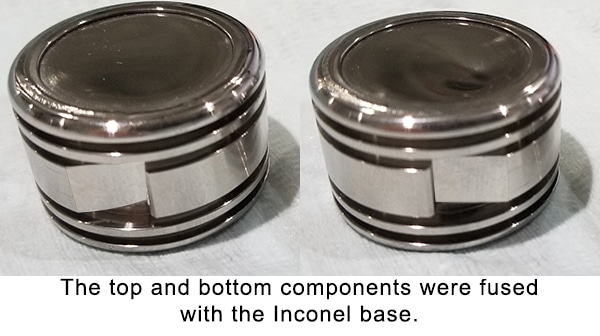
The customer required five small Inconel components to be fused into a single precision assembly. The finished part would be installed into an apparatus used to hold specific isotopes during production.
Inconel, a nickel-chromium-based superalloy, is commonly used in nuclear and high-temperature environments due to its strength, corrosion resistance, and ability to maintain integrity under extreme conditions. However, these same properties make it difficult to weld, particularly when thin sections are involved.
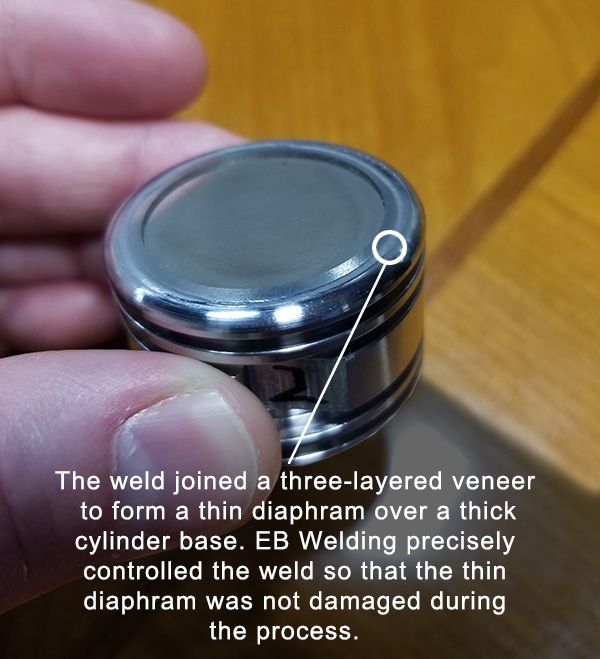
In this application, the components included a thin, multi-layered diaphragm that needed to be joined to a much thicker cylindrical base. The weld needed to partially penetrate the outer veneer without damaging or distorting the diaphragm—a requirement that left virtually no margin for error.
Key challenges included:
Welding light-gauge Inconel without overheating
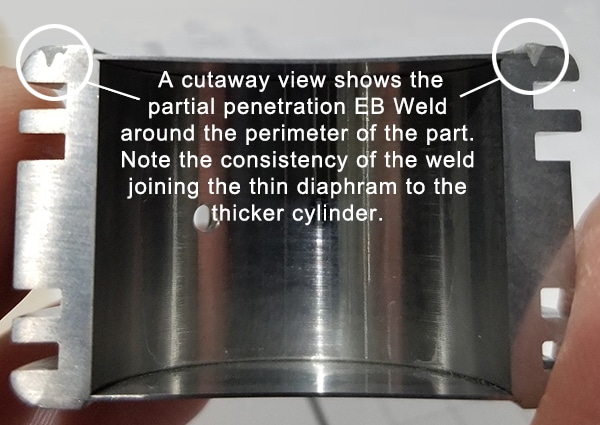
Achieving partial penetration with tight depth control
Preserving the integrity of the thin diaphragm
Producing a seamless, consistent weld around the full perimeter
Preventing any contamination during the welding process
The EB Welding Solution
Electron Beam (EB) welding provided the level of precision required for this application.
Using digitally controlled beam parameters, CF Roark engineers were able to program the exact depth of penetration, regulating beam intensity incrementally as the weld progressed. This allowed the electron beam to fuse the thin veneer to the thicker cylinder base while avoiding damage to the diaphragm on both the top and bottom of the part.
Because EB welding delivers high energy density to a tightly focused area, it is particularly well suited for applications involving thin materials and partial-penetration welds. The result was a small, seamless weld that remained consistent around the entire circumference of the component.
Just as important, the welding process took place inside a high-vacuum chamber, eliminating exposure to atmospheric contaminants. Given the sensitivity of radiopharmaceutical production, cleanliness was a critical requirement. Any microbial or environmental contamination would render the part unusable.
CF Roark engineers worked closely with the customer prior to welding to review specifications, procedures, and cleanliness standards. CF Roark’s ISO 9001 certification was a required qualification for the project and ensured full compliance with the customer’s quality expectations.
Why Electron Beam Welding Was the Right Choice
The completed Inconel assemblies met all performance, dimensional, and cleanliness requirements:
Precise partial-penetration welds with no diaphragm damage
Seamless, uniform weld appearance
Structural integrity maintained under high-heat conditions
Clean, contamination-free components suitable for nuclear pharmaceutical use
The customer was highly satisfied with the outcome and the reliability of the welded components in service.
This project demonstrates why EB welding is frequently selected for small, highly sensitive components used in nuclear, pharmaceutical, and medical applications. Its ability to precisely control penetration depth, minimize heat input, and operate in a vacuum environment makes it uniquely suited for applications where material integrity and cleanliness are non-negotiable.
Need a precision welding solution for your next high-performance project?