Electron Beam Welding Used on Particle Accelerator Cavities
The Facility for Rare Isotope Beams (FRIB) at Michigan State University is a world-class nuclear science research facility built to advance the study of atomic structure and nuclear reactions. At the core of FRIB is a 1,400-foot linear particle accelerator designed to isolate, accelerate, and collide rare isotopes so their properties can be observed and analyzed.
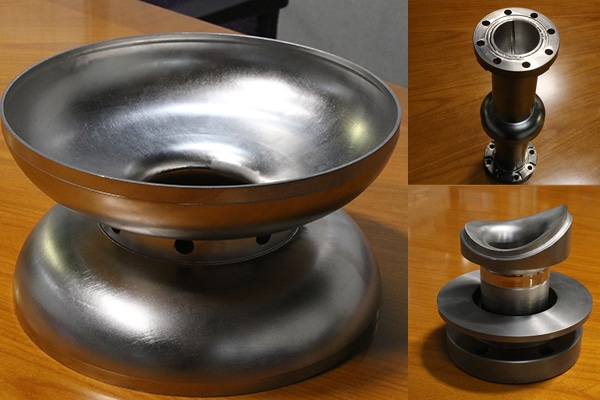
Central to this process are superconducting radio-frequency (SRF) cavities, which serve as the engine that accelerates particles through the beamline. These cavities must support the efficient flow of electricity across their surfaces with extremely low resistance. To achieve this performance, the cavities are manufactured from niobium, a material chosen for its superconducting properties at cryogenic temperatures.
The Challenge
Niobium is exceptionally sensitive during welding. When its temperature rises above a critical threshold in the presence of oxygen, oxidation can occur, permanently degrading its surface properties and superconducting performance. Compounding the challenge, niobium has a very high melting temperature (2,477°C), requiring extraordinary control of heat input and environmental conditions during joining.
In addition to material sensitivity, the welded joints themselves must meet extremely tight requirements. These particle accelerator cavities operate in conditions where even minor surface irregularities can negatively impact electromagnetic performance and efficiency. The primary challenges included:
Preventing oxidation of niobium during the welding process
Managing extremely high melting temperatures without introducing distortion
Maintaining strict control over weld face and root profiles
Achieving a surface finish suitable for superconducting performance
Ensuring consistent, repeatable weld quality across multiple cavities
Traditional welding processes introduce too much variability and environmental risk for an application of this sensitivity, making them unsuitable for meeting FRIB’s performance requirements.
The EB Welding Solution
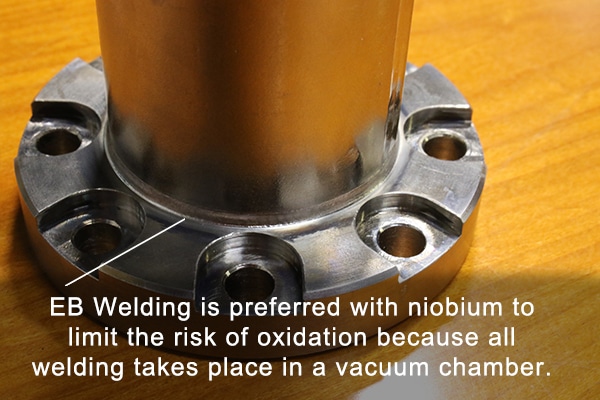
Electron Beam (EB) welding is uniquely suited for welding niobium and other highly reactive elemental metals. From a metallurgical standpoint, the process offers two critical advantages: precise energy control and a high-vacuum environment.
EB welding allows engineers to digitally regulate the amount of energy delivered to a very small, well-defined area—whether performing a surface weld or a joint weld. Because the process takes place inside a vacuum chamber, exposure to atmospheric contaminants is virtually eliminated, significantly reducing the risk of oxidation during welding.
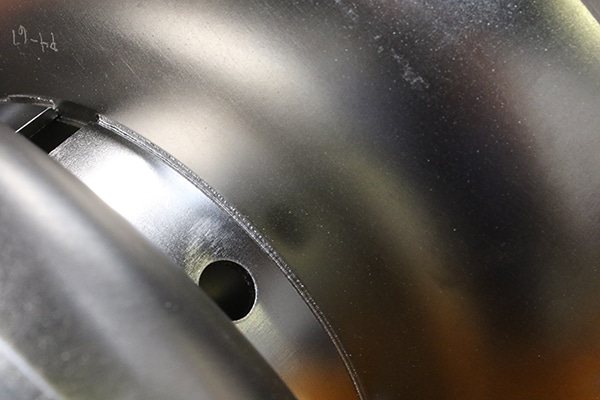
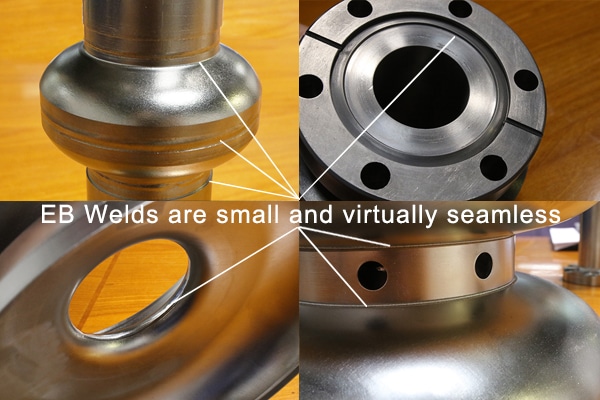
After each weld pass, the cavities are allowed to cool slowly under controlled conditions. This minimizes thermal stress and helps preserve the integrity of the material and the weld profile. The result is a joint that is small, consistent, and virtually seamless, meeting the stringent surface and performance requirements demanded by particle accelerator applications.
Why Electron Beam Welding Was the Right Choice
The completed niobium cavities met all functional and quality expectations for use within the FRIB accelerator system. EB welding enabled CF Roark to deliver:
Clean, uniform welds with minimal visual presence
Strict control of weld profile and surface finish
Preservation of niobium’s superconducting properties
Repeatable results across multiple cavities
At the conclusion of the project, FRIB was extremely satisfied with the performance of the welded components and Roark’s ability to meet the demanding technical requirements of the application.
This project underscores why EB welding is often the preferred joining method for niobium, superconducting components, and other highly sensitive metals. The combination of vacuum welding conditions, digitally controlled energy input, and exceptional repeatability makes EB welding uniquely capable of meeting the requirements of advanced scientific and nuclear research applications.
Need a precision welding solution for your next high-performance project?