Ship’s Exhaust Duct Uses Electron Beam Welding for Bolt Flange
A shipbuilder required a bolt flange to be permanently joined to a large exhaust terminal duct used in a marine exhaust system. The flange needed to align precisely with the bolt pattern of a mating exhaust pipe so the ductwork could be assembled and fastened correctly on the ship’s deck.
Because the components were large and the bolt patterns unforgiving, maintaining flatness and alignment during welding was critical. Any distortion of the flange would lead to misalignment during installation, increasing assembly time and potentially compromising the integrity of the joint.
The Challenge
This application combined large part geometry with tight alignment requirements, creating challenges that traditional welding processes struggle to manage.
The shipbuilder needed a welding process that could:
Join large, heavy components without warping the flange
Maintain precise alignment across the entire bolt pattern
Avoid introducing stress concentrations near bolt holes
Deliver repeatable results across complex geometry
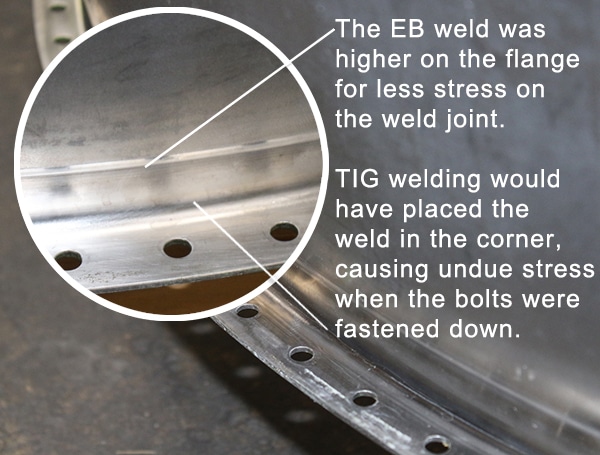
Traditional welding methods typically rely on corner joints placed near the flange edge. In this case, that approach would have created two significant risks: heat distortion near the bolt pattern and increased stress at the joint once the bolts were torqued down.
The EB Welding Solution
Electron Beam (EB) welding offered a level of control that addressed both alignment and structural concerns.
Because EB welding is digitally controlled through CNC programming, the weld path, speed, and penetration depth could be precisely defined and repeated without variability. Multi-axis control allowed the weld to follow the complex geometry of the duct while maintaining consistent parameters throughout the process.
One of the most important advantages of EB welding in this application was weld placement. Instead of placing a corner weld near the bolt holes, EB welding allowed a butt weld to be positioned higher on the upright section of the flange. This relocated the joint away from the bolt pattern, reducing stress on the fasteners and improving the overall load distribution of the assembly.
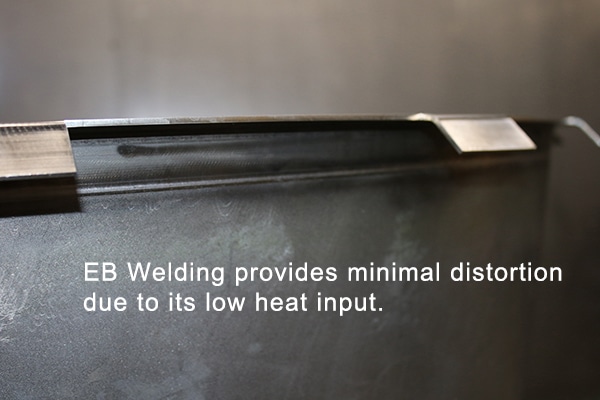
In addition, EB welding’s low heat input minimized thermal distortion. By concentrating energy into a narrow fusion zone, the process reduced the risk of warping adjacent surfaces, ensuring the flange remained flat and aligned for installation.
Why Electron Beam Welding Was the Right Choice
The finished exhaust duct assembly met all alignment and structural requirements:
Precise bolt flange alignment with mating exhaust components
Minimal distortion despite large part size
Improved joint integrity due to optimized weld placement
Clean, consistent weld appearance
By repositioning the weld and controlling heat input, CF Roark delivered a solution that simplified installation and improved the long-term performance of the exhaust system.
This project highlights EB welding’s ability to solve problems that go beyond simply joining metal. Its combination of precise weld placement, low heat input, and repeatability makes it ideal for large fabricated assemblies where alignment, stress distribution, and installation efficiency are critical.
Need a precision welding solution for your next high-performance project?